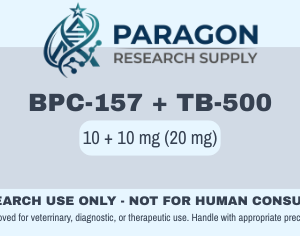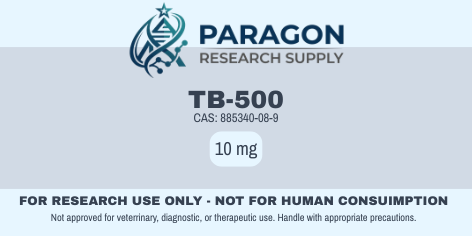
TB-500 | 10 mg | Research Grade Peptide
Full Compound Name: Thymosin Beta-4 Fragment (Ac-LKKTETQ); TB-500; Tβ4 (17–23) Acetylated Analogue Molecular Formula: C₂₁₂H₃₅₀N₅₆O₇₈S Molecular Weight: 4,963.44 Da CAS Number: 885340-08-9 (Thymosin Beta-4); TB-500 is the synthetic peptide fragment analogue Purity: ≥98% (HPLC) Appearance: Lyophilized white to off-white powder Quantity: 10 mg per vial
Description
TB-500 is a synthetic analogue of the highly conserved 43-amino acid polypeptide Thymosin Beta-4 (Tβ4), a member of the beta-thymosin family of G-actin sequestering proteins ubiquitously expressed across eukaryotic cell types. The compound corresponds to the principal actin-binding domain of the full-length Tβ4 sequence, encompassing the conserved LKKTET motif (residues 17–23), which constitutes the biologically active fragment responsible for G-actin monomer sequestration and filamentous actin (F-actin) dynamics modulation in cell-free and cell culture systems.
TB-500 has been employed extensively as a research tool in cytoskeletal biology, where it serves as a model substrate for investigating actin polymerization kinetics, cell motility signalling, and the biophysical interactions between beta-thymosin peptides and monomeric actin. The compound is of academic interest across disciplines including cell biology, biophysics, and molecular pharmacology, and has been used in preclinical models to study endothelial cell migration, angiogenesis signalling cascades, and inflammatory mediator modulation in vitro.
Amino Acid Sequence
Ac-Leu-Lys-Lys-Thr-Glu-Thr-Gln-OH
(7-residue synthetic fragment; N-terminally acetylated; corresponds to the actin-binding LKKTET motif of human Thymosin Beta-4)
Physicochemical Properties
| Property | Value |
|---|---|
| Molecular Formula | C₂₁₂H₃₅₀N₅₆O₇₈S |
| Molecular Weight | 4,963.44 Da |
| Solubility | Soluble in sterile water and aqueous buffer (pH 7.4) |
| Form | Lyophilized powder |
| N-Terminal Modification | Acetylated (Ac-) |
| Counter Ion | Acetate or TFA (lot-specific; see CoA) |
Storage Instructions
- Long-term storage: −20°C in a sealed, desiccated environment
- Working aliquots: May be stored at 4°C for up to 7 days once reconstituted; avoid repeated freeze-thaw cycles
- Light sensitivity: Protect from ultraviolet and ambient light at all times; store in original amber vial or wrapped in aluminium foil
- Reconstitution: Reconstitute in sterile deionized water or phosphate-buffered saline (pH 7.4); gentle agitation is recommended; avoid vortexing
- Handling: Use standard laboratory PPE; handle under aseptic conditions appropriate to the research protocol
Documentation
Each vial is supplied with a Certificate of Analysis (CoA) confirming identity, purity (≥98% by HPLC), N-terminal acetylation verification, and mass confirmation by ESI-MS.
⚠ Compliance & Regulatory Statement
This product is intended exclusively for in vitro and laboratory research purposes by qualified scientific personnel. It has not been evaluated, approved, or authorized by Health Canada, the U.S. Food and Drug Administration, or any other regulatory authority for use in humans or animals. This product is not a drug, medicinal product, or dietary supplement, and is not approved for human or veterinary consumption, administration, or therapeutic use of any kind. No health, safety, or efficacy claims are made or implied. The purchaser assumes full responsibility for compliance with all applicable federal, provincial, and local regulations governing the acquisition, handling, storage, and use of research chemicals. For research use only.