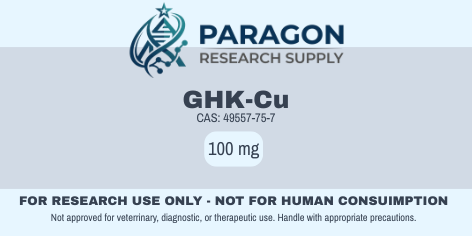
GHK-Cu | 100 mg | Research Grade Peptide-Copper Complex
Full Compound Name: Glycyl-L-histidyl-L-lysine copper(II) complex (GHK-Cu) Molecular Formula: C₁₄H₂₃CuN₆O₄²⁺ (copper(II) complex) Molecular Weight: 403.91 Da CAS Number: 49557-75-7 Purity: ≥98% (HPLC) Appearance: Lyophilized blue to blue-violet powder Quantity: 100 mg per vial
Description
Glycyl-L-histidyl-L-lysine copper(II) (GHK-Cu) is a naturally occurring tripeptide-copper complex first isolated from human plasma, where it is present as a constituent of the albumin fraction. The compound is formed via coordinative binding of the tripeptide GHK to a cupric ion (Cu²⁺) through the amino terminus, the imidazole nitrogen of the histidyl residue, and the deprotonated amide nitrogen of the glycyl-histidyl peptide bond, yielding a square-planar coordination geometry characteristic of type-II copper complexes.
GHK-Cu has been the subject of extensive peer-reviewed investigation owing to its capacity to chelate and transport copper(II) ions across biological membranes in vitro, and its utility as a model ligand in studies of peptide-metal coordination chemistry. The compound is of academic interest in fields including coordination chemistry, bioinorganic chemistry, and extracellular matrix biology research, where it has been employed to probe copper-dependent enzymatic pathways and gene expression modulation in cell culture systems.
Amino Acid Sequence
Gly-His-Lys · Cu²⁺
(Tripeptide; copper(II) coordination occurs via N-terminal amine, imidazole-N³ of His, and deprotonated amide nitrogen; lysine ε-amine remains uncoordinated under physiological pH conditions)
Physicochemical Properties
| Property | Value |
|---|---|
| Molecular Formula | C₁₄H₂₃CuN₆O₄²⁺ |
| Molecular Weight | 403.91 Da |
| Solubility | Freely soluble in water and aqueous buffer (pH 6–8) |
| Form | Lyophilized powder |
| Colour | Blue to blue-violet (characteristic of Cu²⁺ coordination) |
| Counter Ion | Acetate or chloride (lot-specific; see CoA) |
Storage Instructions
- Long-term storage: −20°C in a sealed, desiccated environment
- Working aliquots: May be stored at 4°C for up to 14 days once reconstituted in sterile aqueous buffer; avoid repeated freeze-thaw cycles
- Light sensitivity: Protect from ultraviolet and ambient light at all times; store in original amber vial or wrapped in aluminum foil
- Reconstitution: Reconstitute in sterile deionized water or phosphate-buffered saline (pH 7.4); the compound exhibits high aqueous solubility at neutral pH
- Handling: Use standard laboratory PPE appropriate to copper-containing compounds; handle under conditions suitable to the research protocol
Documentation
Each vial is supplied with a Certificate of Analysis (CoA) confirming identity, purity (≥98% by HPLC), copper content, and mass verification by ESI-MS.
⚠ Compliance & Regulatory Statement
This product is intended exclusively for in vitro and laboratory research purposes by qualified scientific personnel. It has not been evaluated, approved, or authorized by Health Canada, the U.S. Food and Drug Administration, or any other regulatory authority for use in humans or animals. This product is not a drug, medicinal product, or dietary supplement, and is not approved for human or veterinary consumption, administration, or therapeutic use of any kind. No health, safety, or efficacy claims are made or implied. The purchaser assumes full responsibility for compliance with all applicable federal, provincial, and local regulations governing the acquisition, handling, storage, and use of research chemicals. For research use only.